
.png)
.png)
Banbury Avenue 132kV Cable Upgrade Cable Rating, Routing
United Kingdom
Cable Rating, Routing. Feasibility & Detailed Design
Scottish Southern Electricity Networks
All works completed in-house
Delivering a viable route for a new 132kV cable circuit despite gaps in the existing duct network.
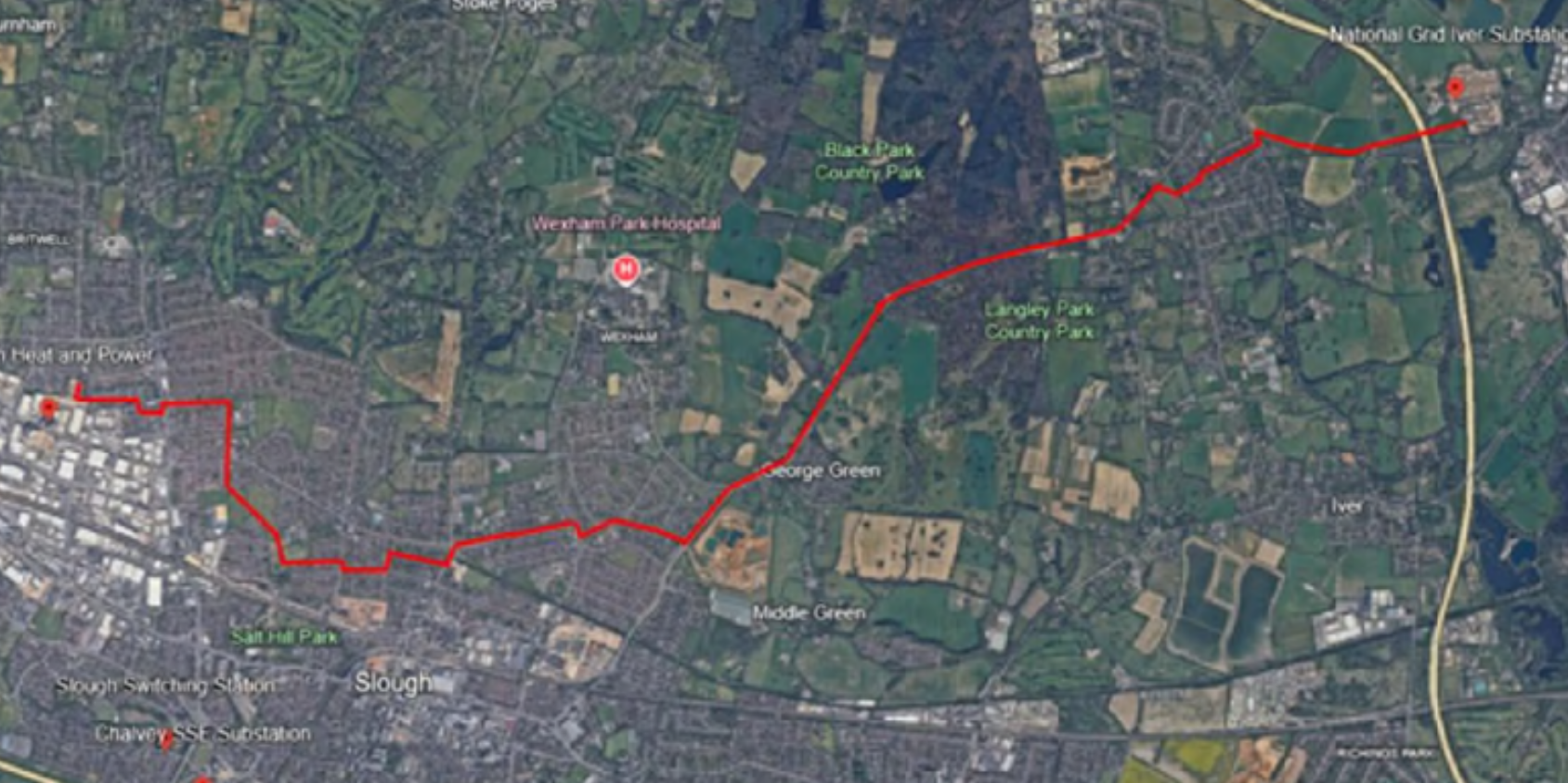
Groundline was appointed to undertake the feasibility and detailed design of the 12km Slough 5 132kV cable circuit, connecting Iver GSP and Slough Grid Primary Substations. The scheme planned to utilise spare duct infrastructure installed during the earlier Slough 4 project, but a review of existing drawings revealed two sections along the proposed route where ducts had not been installed — leaving a discontinuous network and threatening the deliverability of the entire scheme.
Groundline undertook a comprehensive desktop study to prove the proposed route and resolve the identified constraints.
This included cable current rating analysis, cable size selection, geotechnical design specifications, and identification of joint bay locations and installation limitations. A full suite of design deliverables was produced covering route and profile drawings, joint bay layouts, cable and bonding schedules, EMF and induced voltage assessments, thermal and short-circuit ratings, installation methodology, and supporting bills of quantities. Technical assessments were carried out using CYMCAP, modelling SSEN-approved cable options including a 132kV 630mm² Cu XLPE Aluminium Sheath HDPE cable to confirm current ratings, performance, and soil dry-out limits for a trefoil ducted installation. Construction requirements were defined including joint bay locations and a cable pulling strategy aligned with the existing duct orientation from Slough to Iver.
Disruption to the local community minimised through re-use of existing infrastructure despite incomplete asbuilt records.
By proving the existing duct routes and developing a robust detailed design for installation and pulling, Groundline enabled the project to proceed without new duct construction. This significantly reduced community disruption, lowered construction risk and cost, and overcame the challenges posed by gaps in the asbuilt records — delivering a reliable and efficient solution for the new 132kV cable circuit.


2/155 Blenheim Road,
Riccarton,
Christchurch 8041
1 SE Ocean Blvd
Stuart, FL 34994
Geneva Building 2,
Lake View Drive,
Nottinghamshire
NG15 0ED










Copyright ©2026 Groundline Engineering Ltd. All rights reserved
Groundline Engineering Limited | Registered Office: 2-4 Packhorse Road, Gerrards Cross, Buckinghamshire, England, SL9 7QE. | Registered in England and Wales No. 08893929 | VAT No. GB 221 4674 30.